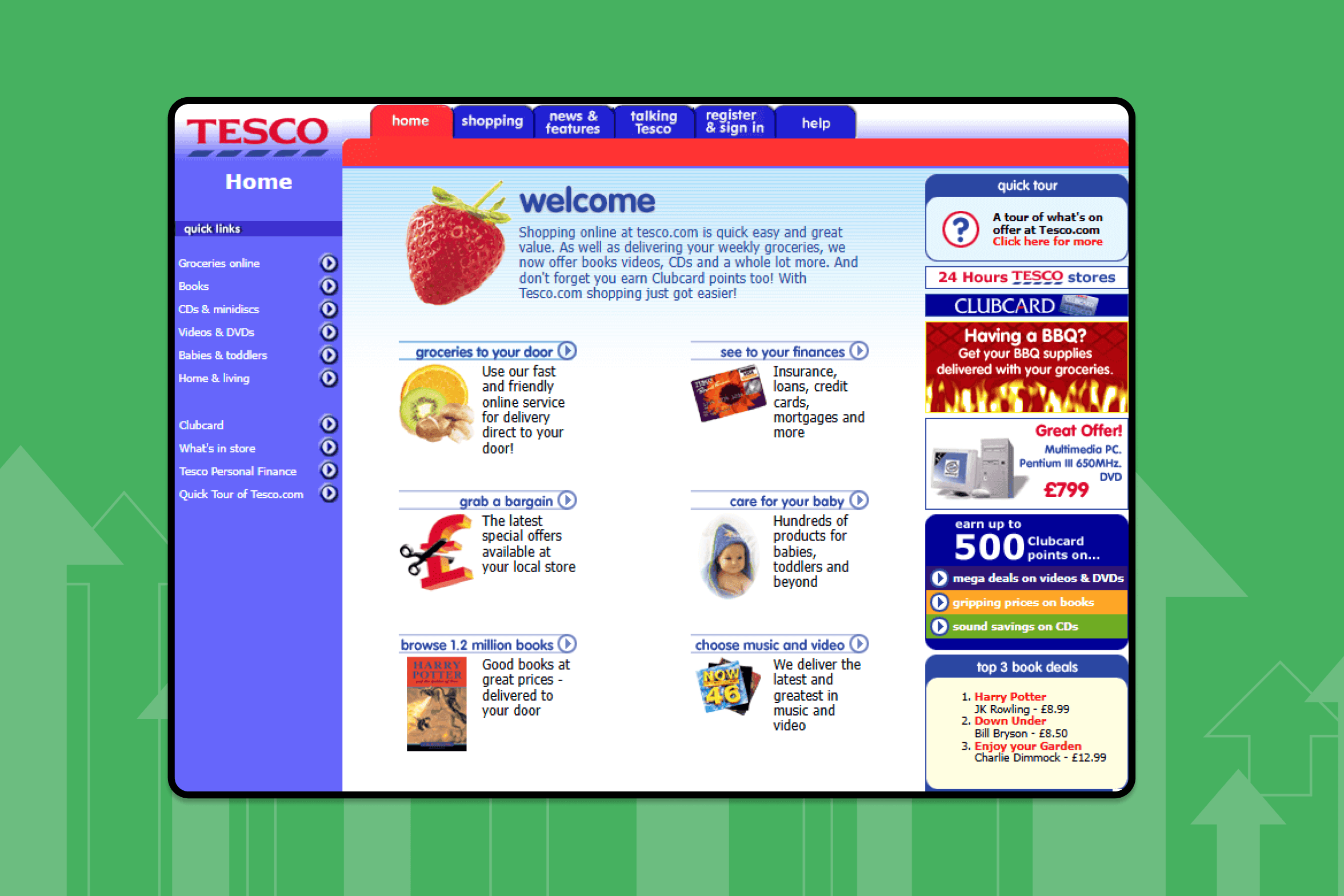
Tesco's accessible early website from 2002 to 2004
Around the early 2000s, Tesco, a major UK supermarket, rebuilt its online shopping experience with accessibility as a core requirement. The team focused on clearer structure, better forms, faster performance for slow connections, and an interface that worked well for screen reader users and keyboard-only users. The goal was that a customer could buy a typical basket of items quickly, even over a 56K modem. [accessicart]
The results were huge. Within a year of the redesign, Tesco’s online sales rose sharply: reported revenue from the accessible site reached about £13 million per year from customers who previously could not shop easily online. Overall online sales grew by roughly 350% around that time, from about £52 million in 2000 to roughly £235 million in 2001, and weekly orders grew from tens of thousands to hundreds of thousands during peak seasons. The redesign cost was about £35,000, which translated into an enormous return on investment. [w3]
The lesson: accessibility is good business
Tesco learned that accessible design is also faster, clearer design. When forms are well structured, labels are obvious, and flows are simple, people complete orders more quickly. That helps everyone, not just customers with disabilities. [accessicart]
There is also a reach effect. When a site works with assistive tech and on low-bandwidth devices, more people can use it in more contexts. That means more customers, more completed purchases, and fewer people dropping out in the middle of a checkout. For an e‑commerce team, accessibility improves conversion and reduces friction at the exact points where money changes hands. [w3]
if you want to checkout Tesco's 2000s webpage, you can do so at the following link:
https://www.webdesignmuseum.org/gallery/tesco-in-2000
and you can reference the official case study from w3c here.
https://www.w3.org/WAI/business-case/archive/tesco-case-study