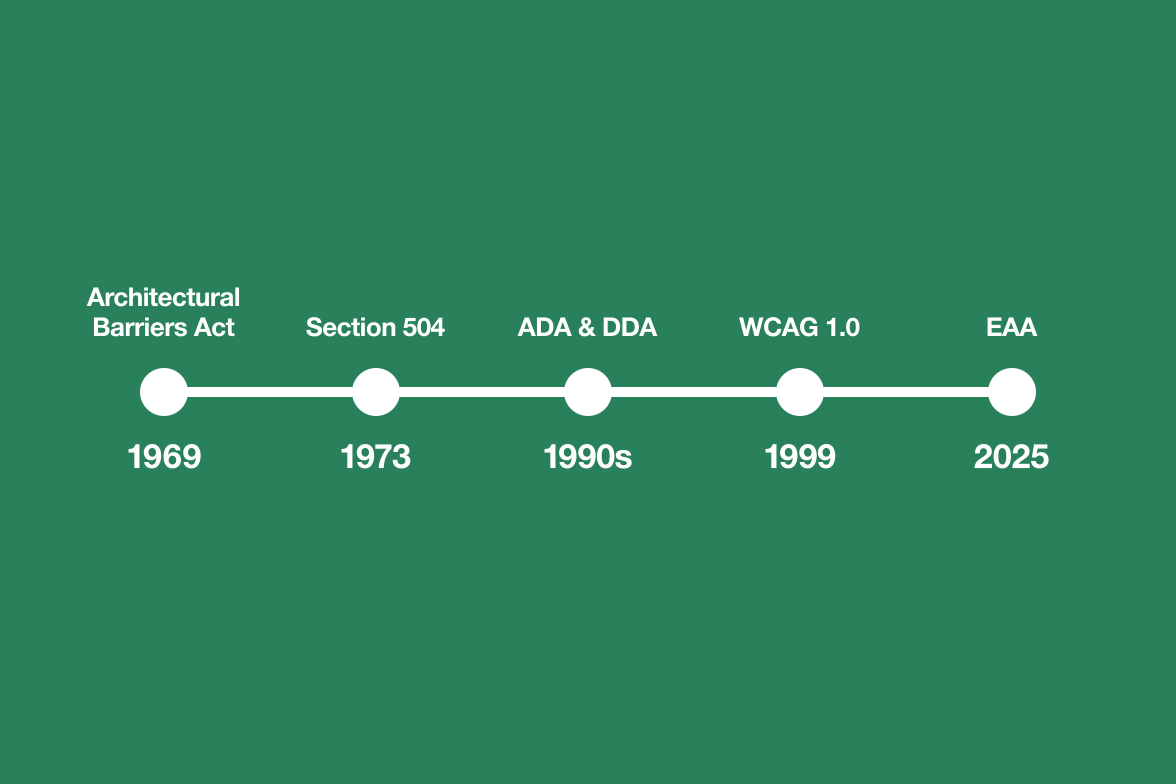
Accessibility law has evolved steadily from physical spaces to the web.
Accessibility did not start with websites. It began with a simple question: how do we make everyday life usable for everyone? Early accessibility rules focused on the built environment: buildings, streets, and public spaces.
1960s–1970s: Physical Barriers Addressed
In the U.S., the Architectural Barriers Act of 1968 required federally funded buildings to include ramps, elevators, and signage. In Europe, the Council of the European Communities Resolution of 1974 launched joint programs for social and vocational inclusion of disabled people, promoting barrier-free public spaces across member states. These efforts led to standards like ANSI A117.1 in the U.S. and similar technical guidelines in Europe for accessible design.
The Rehabilitation Act of 1973 (Also known as U.S. Section 504) banned discrimination in federal programs, while European countries like Spain passed the LISMI Law (1982) to install ramps and elevators nationwide.
1980s–1990s: Civil Rights and Broader Protections
The 1990s marked accessibility as a civil right. The Americans with Disabilities Act (ADA) of 1990 covered workplaces, transport, and services in the U.S., influencing global change. In Europe, the UK Disability Discrimination Act (DDA) of 1995 prohibited discrimination in employment, goods, services, and transport, leading to the EU Employment Equality Directive (2000) for disabled workers across the EU.
2000s: Digital Accessibility Emerges
As the internet grew, laws expanded to digital spaces. U.S. Section 508 (1998 update) required accessible federal tech, and courts applied ADA to websites. In Europe, the Web Accessibility Directive (WAD) (2016) mandated accessible public-sector websites.
The WCAG 1.0 (1999) by W3C provided the first global web guidelines, evolving to WCAG 2.x standards today.
2010s–Now: Unified Global Standards
Newer laws like Canada’s AODA (2005), Australia’s updates, and the European Accessibility Act (EAA, 2019, effective 2025) extend accessibility to e-commerce, apps, banking, and devices across the EU, all referencing WCAG 2.1 AA.
For designers, this history, from ramps to responsive websites, shows one truth: accessibility is a right, and good design makes it happen everywhere.